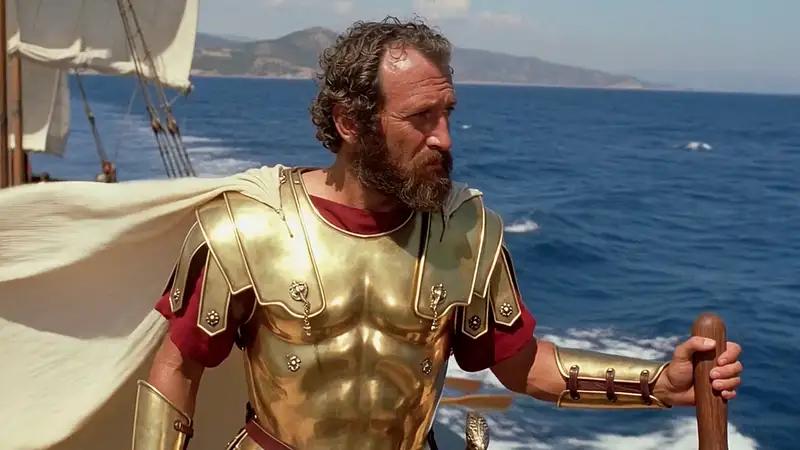


Imagine sitting down to watch a movie about ancient Greece. Ships sail across the sea, warriors prepare for battle, and a legendary hero gets ready to leave his family behind. The scenes look almost real. The actors look convincing. The scale feels cinematic.
Now imagine that much of what you’re watching was generated using artificial intelligence.
That’s the idea behind Grok’s new AI-generated adaptation of The Odyssey. Elon Musk’s AI platform has released the first seven minutes of the project, giving viewers an early look at what could become a very different way of making movies.
But here’s the interesting part: the technology might be more impressive than the film itself.
Seven minutes after months of anticipation
On October 23, Grok Imagine shared the opening episode of its AI-generated Odyssey series on X. The project was developed in collaboration with Wonder Studios and director Dev Walker, both associated with AI filmmaking. Source: Variety
The release follows Musk’s announcement in July that Grok Imagine would produce a full-length, historically accurate adaptation of Homer’s ancient Greek epic before the end of 2026.
That was an ambitious promise. Making a convincing seven-minute video is one thing. Building an engaging feature-length film, with consistent characters, a coherent story and emotional depth, is an entirely different challenge.
For now, viewers have only the opening instalment. There is no confirmed public release schedule for the remaining episodes or the complete film.
So, does this first look live up to the excitement?
The answer is a little complicated.
What happens in Grok’s version of The Odyssey?
The story follows Odysseus as he prepares to leave for the Trojan War. His wife, Penelope, faces the prospect of his departure, while their young son, Telemachus, is introduced into a story that will eventually span years of conflict, separation and adventure.
We see ships, warriors, dramatic landscapes and characters preparing for the journey ahead. Some shots of the ships and sea are strikingly realistic, giving a glimpse of how far AI-generated video has progressed.
And that matters.
Not long ago, AI-generated videos were easy to recognise. Faces changed between frames, hands looked unnatural, objects appeared and disappeared, and movement often felt strangely disconnected from reality.
Today’s systems can produce footage that, at least in individual shots, looks remarkably convincing.
Grok’s Odyssey demonstrates that progress. But looking convincing and telling a convincing story are two very different things.
The visuals are impressive. The storytelling is another matter.
The early reaction from reviewers has been mixed, with criticism focusing on the narration, dialogue and pacing.
TechCrunch’s Anthony Ha noted that some scenes looked more realistic than expected, but argued that the overall video lacked artistic inspiration and emotional engagement. The extended narration and stiff dialogue made the seven-minute episode feel longer than it was. Read the TechCrunch review
That criticism gets to the heart of the problem.
A movie isn’t simply a sequence of attractive images. It’s the reason we care about what happens between those images.
Think about the best films you’ve watched. You probably remember a moment when a character made a difficult choice, a conversation that changed everything, or a scene that left you thinking about it long after the credits rolled.
Those moments depend on much more than visual quality. They require pacing, character development, dialogue, music, direction and a sense of when to say something—and when to remain silent.
AI can help create a dramatic shot of a fleet sailing towards the horizon. But can it make us feel the anxiety of a father leaving his family, or the loneliness of a child growing up without him?
That is the harder test.
Grok’s first episode suggests that generating cinematic-looking footage is becoming easier. Making that footage emotionally meaningful remains a much bigger challenge.
The Christopher Nolan comparison is impossible to ignore
There is another reason this release has attracted attention.
Christopher Nolan’s live-action adaptation of The Odyssey has been a major cinematic talking point in 2026. Musk previously criticised Nolan’s casting choices and subsequently promoted his own AI-generated version of the Greek epic.
The two projects represent very different approaches to filmmaking.
Nolan’s production involved real-world locations, physical sets, human performances and a large production crew. Grok’s project uses generative AI to create its visual world, with Wonder Studios and Dev Walker credited as collaborators.
The comparison is not entirely fair. A seven-minute opening episode should not be judged as though it were a finished, feature-length film. Nor does the use of AI automatically make a production less creative.
Still, the comparison raises a useful question: if AI can create cinematic images much more cheaply and quickly than traditional production methods, what will audiences continue to value about human filmmaking?
The answer may be more than some technology enthusiasts expect.
A director’s job is not just to produce images. It is to make choices, establish meaning, guide performances and build an emotional connection with the audience. AI can assist with parts of that process, but the quality of the finished work still depends on how the pieces come together.
Could AI make movies dramatically cheaper?
This is where things get genuinely interesting.
Traditional filmmaking is expensive for a reason. Productions need actors, crew members, locations, sets, costumes, equipment, editing facilities and months of coordination. Fantasy and historical films can be particularly costly because of their scale.
AI tools could reduce some of those costs.
Imagine an independent filmmaker who has written a compelling historical drama but cannot afford a large production. With AI-assisted video generation, that filmmaker might be able to create convincing environments, experiment with different visual styles and produce scenes that would previously have required a substantial budget.
A small creative team could potentially explore ideas that once belonged exclusively to well-funded studios.
That is an exciting possibility, and it could eventually open filmmaking to more people.
But cheaper production does not automatically mean cheaper storytelling—or a successful film.
Someone still has to write a good script, decide which scenes work, maintain continuity, edit the footage, manage sound and ensure the final product holds together. Generating multiple versions of a scene may also require considerable time and computing resources.
And there are other questions: who owns the generated material, what permissions are required for training data and synthetic performances, and how should audiences be informed when a film uses AI?
These are not minor details. They will help determine whether AI filmmaking becomes a sustainable industry or simply another way to produce an endless stream of disposable content.
What does this mean for actors, directors and filmmakers?
It would be premature to declare that AI is about to replace Hollywood.
The more realistic possibility is that filmmaking changes gradually, with AI taking on some tasks while humans continue to shape the creative process.
AI could help with storyboarding, previsualisation, background environments, visual effects, dubbing and early-stage experimentation. It could also allow small teams to create ambitious scenes without assembling a traditional production on the same scale.
At the same time, the industry will have to address the rights and livelihoods of performers, writers and other creative professionals.
There is a difference between using AI to help a director explore a scene and generating an actor’s likeness or performance without permission. There is also a difference between reducing repetitive production work and eliminating the people whose creative decisions give a film its identity.
The technology is moving quickly, but the industry’s rules and working practices will need to evolve alongside it.
The real question: Can AI make us care?
For all the discussion about technology, computing power and production costs, I think this is the question that matters most.
Can an AI-generated film make an audience laugh, cry, feel suspense or become deeply invested in a character?
It doesn’t necessarily matter to viewers how a scene was created if the finished film is compelling. Audiences have embraced digital effects, computer-generated characters and entirely fictional worlds for decades.
But they still expect a story worth watching.
Grok’s Odyssey is an interesting experiment because it puts that distinction into focus. The visuals can look convincing, yet the experience can still feel flat if the narration drags, the dialogue lacks natural rhythm or the characters fail to make us care.
That doesn’t mean AI filmmaking has failed. It means visual realism is only one part of the equation.
And there is plenty of room for improvement.
What happens next?
The immediate question is whether Grok will release more episodes and ultimately deliver the full-length film Musk promised.
A detailed production breakdown would also be useful. Grok Imagine has invited viewers to express interest in learning how the episode was made, but the creators have not yet publicly explained exactly how much of the writing, visual generation, voice work and editing was automated.
That information would help us distinguish between what the technology can do independently and what required human direction and production work.
It would also help aspiring filmmakers understand whether this approach is practical for their own projects.
For now, it is best to treat the seven-minute release as an early demonstration rather than definitive proof that AI can replace traditional filmmaking.
GadgetGyan’s verdict
Grok’s Odyssey is worth watching—not necessarily because it is a great film, but because it offers a glimpse of where AI-generated entertainment is heading.
The visual progress is hard to dismiss. Scenes that once would have required extensive sets, costumes, locations and visual-effects work can now be explored using generative tools.
Yet the early criticism also reveals an important limitation. A convincing image can grab our attention, but it cannot carry an entire film on its own.
The next big breakthrough in AI filmmaking may not be making videos look more realistic. It may be making them feel more human.
If Grok and other AI platforms can combine convincing visuals with stronger dialogue, consistent characters and genuinely engaging storytelling, the implications for entertainment could be enormous.
Until then, Hollywood probably doesn’t need to panic just yet.
The cameras may be changing. The tools may be changing. But audiences still want the same thing they’ve always wanted: a story that makes the time they spend watching worthwhile.
What do you think? Would you watch a full-length AI-generated movie if the story was genuinely good, or does knowing that it was created by AI change the experience for you? Share your thoughts with GadgetGyan.